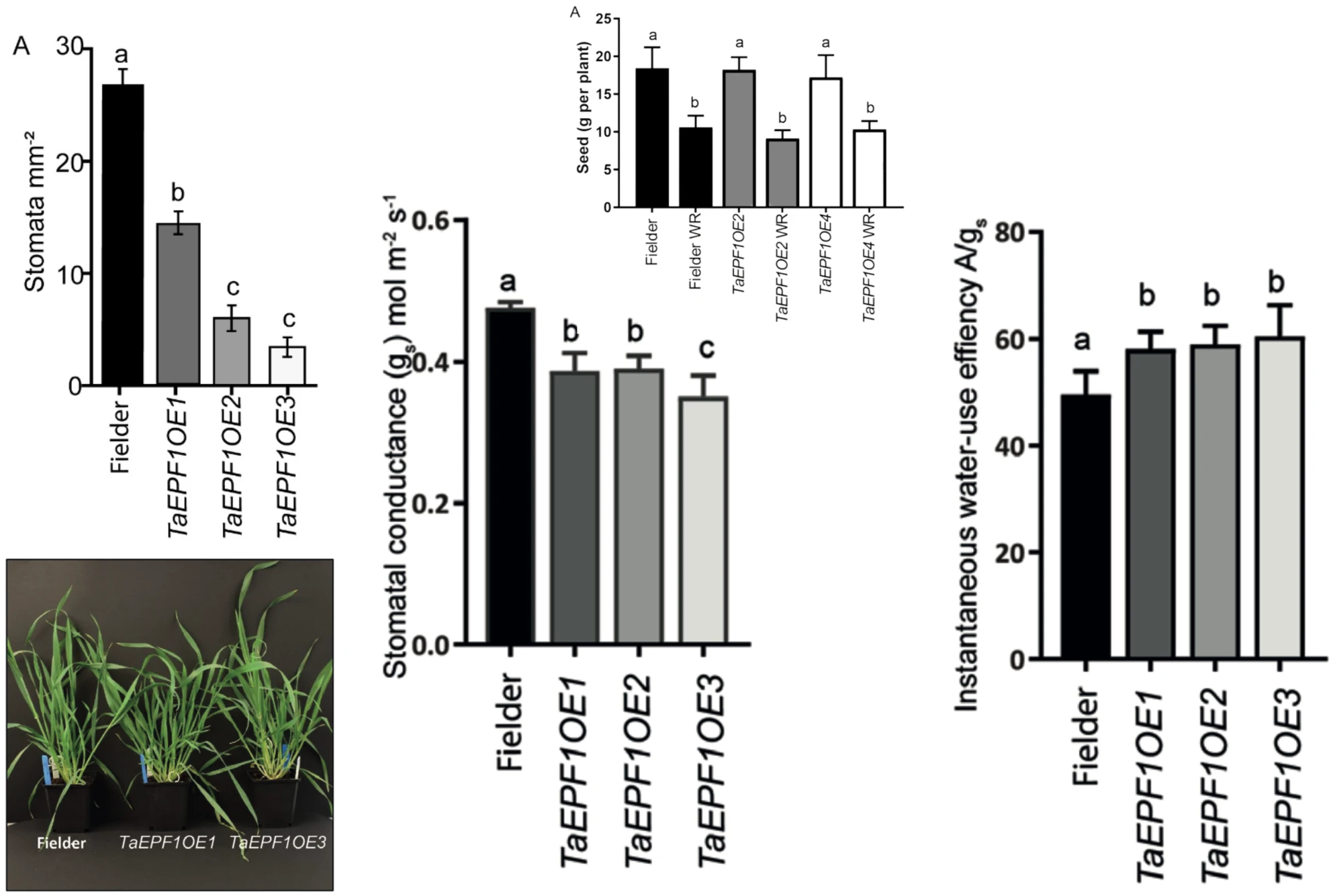
A substantial reduction in stomatal density improved intrinsic water-use efficiency without a detected grain-yield penalty under the conditions tested, including drought and elevated CO₂.
Breed the stomatal strategy that fits the target environment.
Bring stomatal anatomy into field-scale breeding decisions — and reveal how each genotype balances carbon gain, water loss and leaf cooling under the conditions it is meant to face.
There is no universal “best” stomatal phenotype.
Stomata regulate the exchange of CO₂ and water vapour. Their behaviour influences photosynthesis, transpiration, leaf temperature and plant water status — but the value of any stomatal trait depends on the crop, growth stage and environment.
Lower water loss can be advantageous during prolonged drought. In hot conditions with available water, higher conductance may instead protect photosynthesis through transpirational cooling. Under rapidly changing light or atmospheric demand, response speed becomes critical.
Strong potential.
Context-dependent outcomes.
Published work supports stomatal traits as actionable breeding targets while consistently showing that outcomes depend on genotype, crop and environment.
Contrasting strategies.
One context-dependent choice.
These are not fixed recipes. They are interpretable phenotypes to compare, connect with physiology and validate under representative conditions.
Protect the water reserve.
A moderate reduction in stomatal density or opening capacity can reduce transpiration and improve intrinsic water-use efficiency.
- Prolonged or terminal drought
- Limited soil-water reserve
- Predictable water deficit
Trade-off to test: carbon assimilation and evaporative cooling.
Adjust quickly to opportunity and risk.
Smaller, often more numerous stomata may support faster conductance changes as light, temperature and atmospheric demand fluctuate.
- Fluctuating light and VPD
- Heat with access to water
- Environments with favourable windows
Trade-off to test: excessive water use during high demand.
Many successful genotypes may express an intermediate or stage-specific strategy. Anatomy provides the hypothesis; field performance provides the answer.
Designed around your target environment.
Stomatal phenotyping at breeding scale.
STOMmini and STOM compare stomatal phenotypes across genotypes, treatments and environments — turning image acquisition into a focused validation strategy.
Discuss your target environments →Define
Target environments, stress scenarios and the selection objective.
Phenotype
Screen genetic diversity at scale with a standardised imaging protocol.
Characterise
Density, size, aperture, morphology and spatial architecture.
Contextualise
Combine trial metadata today, with expanded weather and sensor integration in development.
Compare
Identify conservative, responsive and intermediate genotype × environment profiles.
Validate
Prioritise candidates and confirm them in representative field trials.
Start with the environment, not the trait.
Position the target population of environments by water availability and atmospheric demand before defining a useful stomatal hypothesis.
Select any step above to exploreWhich strategy best protects yield
in your target environment?
MIAtecs helps reveal which strategy is already present in your germplasm — and test where it delivers value.
Design a climate-aware screening campaign